
Middle Betting: Calculator, Software & Guide
This guide explains the mechanics of middle betting, provides a stake calculator, and outlines how tools and execution speed influence viability. Sections are organized by calculation, discovery methods, examples, and risk considerations.


Middle Bet Calculator
The calculator determines stake distribution and potential outcomes based on odds and total exposure, helping users evaluate different settlement scenarios.
Insert the odds and total stake then hit calculate!
Stake Needed
Stake Bet 1
Stake Bet 2
Payout
Payout Bet 1
Payout Bet 2
Payout Middle Hit
- Profit if both wins: $0.00
- Profit if 1 bet wins: $0.00
- ROI if 1 wins: 0.00
The main role of a this calculator is to help bettors find out the right stakes for each outcome.
In stake calculator above, you need to insert the odds (decimal odds format if possible, use this odds converter if needed) and the total stakes you want to place.
After hitting Calculate, the software will display all the crucial information for a correctly placed bet.
The calculator outputs:
- The stakes you need to place on each bet to have the same amount of winnings if both outcomes occur
- The payout of your bets in every scenario: you win only 1 bet, or the teams score the right amount, and you win both bets.
- Profit if both bets win
- Profit if only one bet is a winner
- ROI if a single bet is a winner
What is the definition of middle betting?
Middle betting is a strategy in which a bettor places bets on both sides of the same betting market at different betting sites.
The opportunity for this betting method appears when there is a line difference between two or more betting sites.
Below is a visual explanation of how a line difference between bookies can generate a line discrepancy.
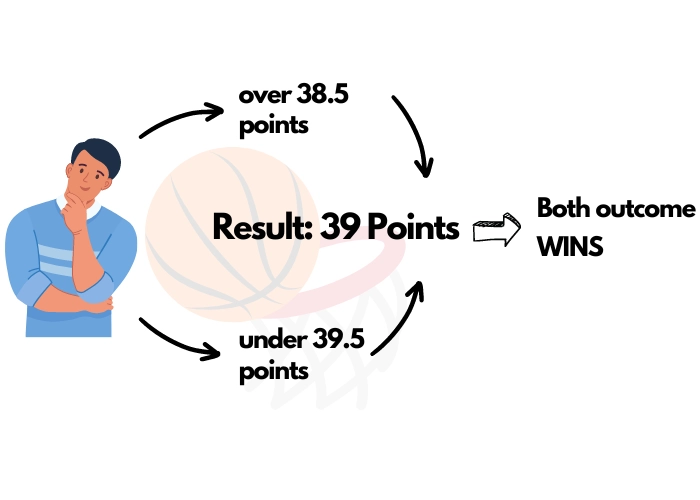
Betting line differences can guarantee even a small profit when done successfully (more below).
How do you find middle bets?
During my betting activity, I used three methods to find a dual-line setup.
- Manually find arbitrage bets with line difference
- With a free software
- Subscription to a premium service
1. Using the manual method
This method of spottingline discrepancy requires the most skill and time investment.
Manual identification requires substantial monitoring and typically yields limited actionable frequency.
You can spot some opportunities manually on smaller, fast-moving markets on tennis, basketball, or even handball.
But the amount of time it needs to find middle bets that are also close to an arbitrage betting opportunity (for bigger profitability and less risk) will not be worth it.
Finding these bets manually might be complementary to arbing and for a value betting-based approach. To always make sure your bet has at least a 0% return, use an arb stake calculator.
2. Using a free middle bet finder
At the moment, only a handful of odds scanner services offer a free tool.
The best tools to find line differences are:
- BetBurger (worldwide)
- ArbMate (mostly Europe)
- Surebet.com (worldwide)
- OddsJam (focusing on the US and Canada)
These services apply a delay or some kind of limitation to their services.
Free tools often apply delays or visibility limits, which reduces the likelihood that listed setups remain executable.
These line discrepancies appear when a bookmaker makes a significant mistake.
Most smart bettors jump on these betting opportunities pretty fast, which results in massive odds/line drops in a matter of seconds.
So, how can you take advantage of these free middle bet finders?
Their main goal is to give you an insight, an idea of how they work.
These services are focusing on other betting strategies, such as arbitrage betting.
But they also display middle betting opportunities.
Getting access to a free tool will help you figure out how to set up filters, which bookies they cover, and figure out if you like the user interface or not.
3. Subscribe to a premium service
Paid tools provide real-time line comparisons and broader bookmaker coverage, which improves execution feasibility.
This will give you access to other premium services, such as sure bet finders or even value bet finders, as well.
While using premium software, you will have the chance to get betting opportunities from several hundred bookies in real time.
Each of these betting strategies got pretty big attention on YouTube and other platforms as well.
This resulted in a fast-growing audience and more people trying to take advantage of a dual-line setup as well.
Executing these setups without real-time data significantly reduces the likelihood of covering both sides at viable prices.
The odds and betting lines on these betting opportunities are shifting so fast that you simply don’t have the chance of covering both outcomes before the odds drop if you do not use a fast scanner.
What is an example of a middle bet that is also an arb?
Here’s an example to illustrate middle with arbitrage included:
Let’s say there’s an upcoming basketball game between Team A and Team B.
Bookmaker X offers the following odds:
- Total corners over 12.5: +120 (2.20 in decimal odds)
- Total corners under 12.5: -130 (1.77 in decimal odds)
At the same time, Bookmaker Y offers the following odds:
- Total corners over 13.5: +105 (2.05 in decimal odds)
- Total corners under 13.5: -116 (1.86 in decimal odds)
To execute a line difference based bet, you would place a bet on Total corners over 12.5 with Bookmaker X at +120 (2.20) and simultaneously place a bet on under 13.5 corners with Bookmaker Y at -116 (1.86).
Here’s how the potential outcomes could result in a profit:
- If there will be 12 corners or fewer in total: In this scenario, your bet on under 13.5 corners with Bookmaker Y would be a winner, resulting in a profit.
Your bet on over 12.5 with Bookmaker X would be a loss, but the profit from the winning bet compensates for the loss, leaving you with a net profit of 0.78% of your total stakes. - If there are 14 corners or more, your bet on over 12.5 with Bookmaker X will be a winner, resulting in a profit.
Your bet on under 13.5 with Bookmaker Y would be a loss, but again, the profit from the winning bet offsets the loss, leaving you with a net profit of 0.78% of your total stakes. - In the narrow scenario where the final result lands between both lines, both positions may settle positively.
The key to successful middle betting is finding discrepancies in the odds offered by different bookmakers, which allows you to create a situation where you can win on both sides or minimize losses.
It requires careful analysis, timing, and a deep understanding of sports betting markets (especially when dealing with handicap market middle bets).
Remember that line discrepancy are rare; not all bettors engage in this strategy.
When can middle betting be viable?
It is profitable when combined with arbitrage betting, or one of the outcomes has a positive Expected Value.
It can potentially be profitable, but it depends on various factors, such as:
- The odds/lines offered by bookmakers,
- The frequency of successful bets,
- The overall strategy employed by the bettor.
With middling, a bettor can place bets on opposite outcomes of the same event and secure a profit regardless of the final outcome.
However, it’s important to note that significant line mistakes are relatively rare and require careful analysis, quick decision-making, and access to multiple bookmakers offering different odds.
Finding and executing suitable opportunities can be challenging, even for experienced bettors.
What are the risks?
- Line movement may occur before both positions are secured.
- One of the bookies voids a bet (most of the time overpriced one). This could mean you will have a voided winner bet and a lost bet, resulting in severe losses.
Overall, middle betting can be a profitable betting strategy for tennis, for example, if implemented effectively and in the right circumstances.
It requires a combination of skill, knowledge, speed, and a keen understanding of the sports betting markets.
Not understanding a handicap market can give you the illusion of finding a great line discrepancy opportunity.
In reality, you may lose each leg of your bets, resulting in a massive loss of profits.
What are the downsides?
This method requires a significant line difference between bookmakers, which can have the following downsides:
- The odds and betting lines shift very fast before you can cover each outcome. This can result in significant losses because of being forced to cover the other outcome on odds/lines that will be available.
- The bookie with the mistaken odds/lines might void the bets or change the odds to the correct one: this means a potentially big loss.
- Focusing too much on this kind of middle betting opportunity can cause the miss of many great, sure/value betting opportunities.
- Bookies are not letting you cover the other outcome with the required stake.
- Because of placing bets on significant mistakes, bookies might flag your account even faster, resulting in early stake limitations or getting banned for arbitrage betting and middling as well.
What are the advantages?
- When done correctly, may complement other price-based strategies in specific scenarios.
- Even free arbitrage bet finder offers a signals with line differences
FAQ
What is an example of a middle bet in sports betting?
Example for a middle bet: NBA match Team A to score over 66.5 points with odds of 2 at the first bookie and to score under 67.5 with odds of 2.01 at another bookmaker. If team A scores a total of 67 points, both bets are winners.
