
If you are researching football betting software or sports betting algorithms in general, this article provides an overview of commonly used analytical tools and platforms.
I have been involved in sports betting research and analysis since 2014 and have tested various betting-related algorithms and data services over the years.
Over time, it became clear that consistent decision-making in sports betting requires structured analysis, probability modeling, and an understanding of market behavior rather than intuition alone.
Software tools that apply mathematical models, statistical analysis, and odds monitoring are widely used to support evaluation, testing, and comparison of betting markets, rather than to ensure outcomes.
Most commonly used sports betting software and analytical tools
Below is a list of betting-related software and algorithmic platforms that I have tested over several years as part of research into odds behavior, statistics, and market efficiency.
Each tool offers a different approach to data analysis, and none of them removes risk or uncertainty from sports betting.
- BetOnValue Review: A legit software for Europeans?

- OddsMonkey Review Updated Opinion + Interview

- ArbMate Review: Affordable Odds Comparison – Tested!
- ProfitDuel Review – Is it legit or waste a of money?

- OddStorm Review: Tried the fastest arbitrage software!

- BetBurger Review & Opinion: Is it really worth it?

- RebelBetting Review with result stats & interview
- BetWasp Review: A Value-Bet Identification Tool for USA & Canada
- Pick The Odds Review: Is it worth it?
- Surebet.com Review – Real User Opinion
- 6 Odds Comparison Sites and Software
- Oddsjam Review: Tested! Is it still worth it?
- OddsJam vs RebelBetting Comparison
- Breaking Bet Review – Opinion after using it
- Outplayed Review – Is it legit?
- BetBurger vs RebelBetting: Which is the best?












1. OddsJam – focused on USA & Canada
OddsJam began offering odds comparison services in 2021 and has continued to expand its platform since then.
The software focuses primarily on aggregating odds data from a wide range of licensed US and Canadian sportsbooks.
Their growth and user base reflect demand for real-time odds comparison and market monitoring, rather than guaranteed betting outcomes.
OddsJam provides services similar in function to RebelBetting, though the two platforms differ in geographic focus and bookmaker coverage.
RebelBetting primarily targets European markets, while OddsJam concentrates on regulated sportsbooks in the United States and Canada.
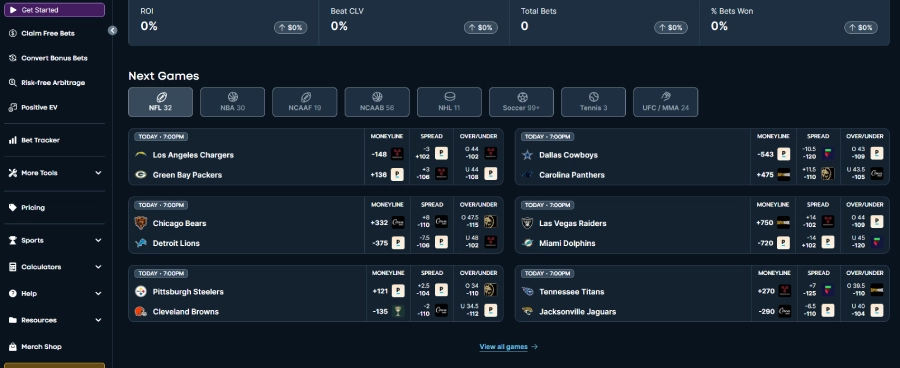
OddsJam interface
The platform includes tools for arbitrage identification and value-based odds comparison, supported by filtering options and a fast data refresh rate.
The software scans both pre-match and live markets, where odds adjustments may occur frequently due to market activity or new information.
Using such tools can help users observe pricing differences and market movements, but it does not eliminate execution risk, timing issues, or account limitations.
Odds discrepancies occur regularly across sportsbooks, but identifying them does not guarantee consistent results, as markets adjust quickly.
Pricing
$199 – Industry plan (arbitrage and value-based analysis tools)
$99 – Arbitrage plan
2. Zcode System – football statistics and prediction modeling
Zcode System follows a different approach compared to odds-scanning platforms.
The service provides access to large historical datasets covering hundreds of thousands of football matches across multiple seasons.
When I tested the platform in 2019, it demonstrated how structured statistical analysis can be used to evaluate football matches retrospectively.
Zcode is often categorized as an AI-assisted football statistics and modeling platform.
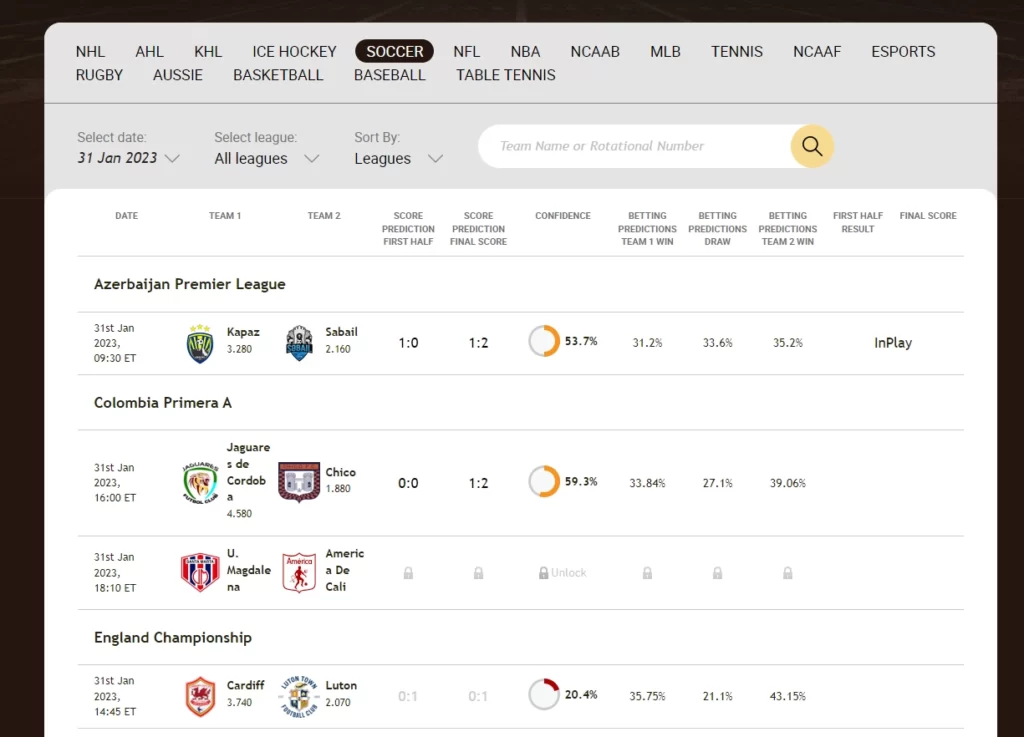
Key capabilities include:
- Pre-match statistical modeling
- Monitoring of odds movement prior to kickoff
- Tools to evaluate betting strategies using historical data and odds behavior
- Notifications based on live statistical triggers
- Identification of matches that meet predefined statistical conditions
The platform offers a 7-day trial for $7, allowing users to evaluate its data and interface before subscribing.
#3. PlayThePercentage – football statistics database
I began using PlayThePercentage around the same time as Zcode System.
Its analytical focus differs from odds-scanning software and can complement other statistical tools.
PlayThePercentage maintains a database of tens of thousands of football matches from recent seasons.
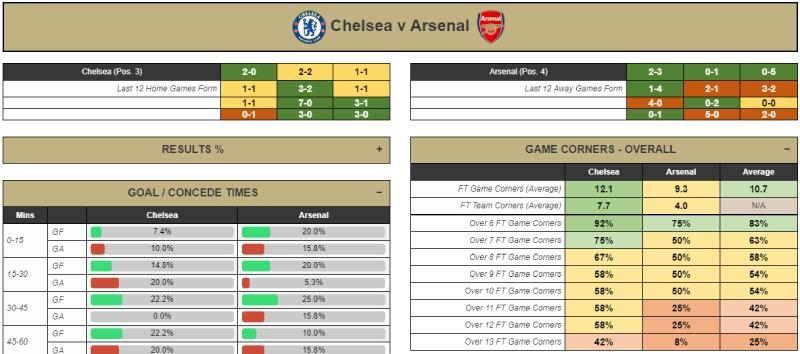
PlayThePercentage interface
The platform presents match statistics and projections in percentage-based formats alongside reference betting lines.
All outputs are derived exclusively from historical data, without incorporating subjective opinions or expert tips.
Users who understand football statistics and odds modeling may use this data to compare assumptions and test hypotheses, rather than to rely on predictions alone.
The platform includes educational guides designed to explain how statistical outputs are generated and interpreted.
A 7-day free trial is available for evaluation purposes.
4. Breaking Bet – entry-level odds monitoring tool
Breaking Bet is a platform I used for an extended period due to its accessibility and relatively low pricing.
Its affordability and interface make it suitable for users who want exposure to odds comparison and market analysis tools.
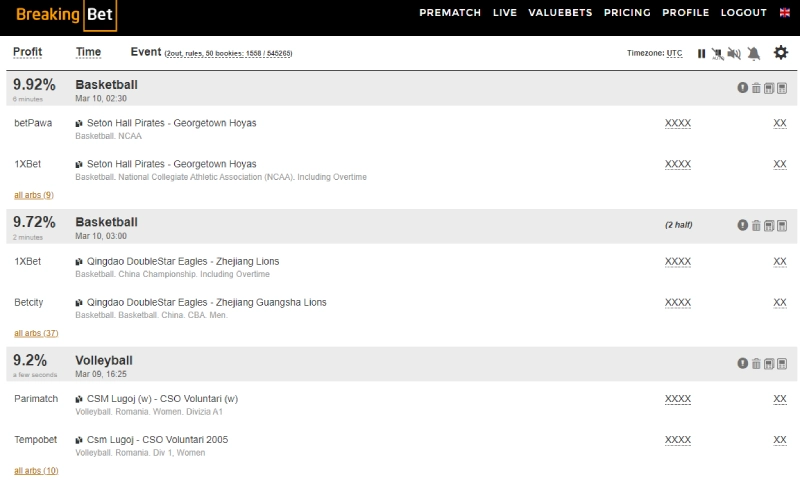
Features include:
- Monitoring odds data from over 180 bookmakers
- Display of arbitrage-style and value-based pricing differences
- Customizable filters and a fast odds refresh rate
- Broad geographic coverage, including Africa and parts of Asia
- Support for both pre-match and live market analysis
While the platform highlights pricing differences, successful use still depends on execution speed, account conditions, and market volatility.
Pricing
Breaking Bet offers several pricing tiers, including:
- €3.99 for 7 days (pre-match value analysis)
- €24.99/month for live arbitrage monitoring
#5. Surebet.com – pre-match software
I started using this software in 2014, primarily to better understand odds discrepancies and how different bookmakers price the same events.
Their system is designed to highlight price differences between bookmakers, which can be useful for analytical comparison of betting markets.
Using Surebet.com for bonus-related strategies is often considered one of the more accessible ways to study matched betting mechanics, particularly from a cost perspective.
After completing introductory bonus-related activity, some users choose to explore arbitrage-style scenarios to better understand how odds alignment works across bookmakers, although results are never guaranteed.
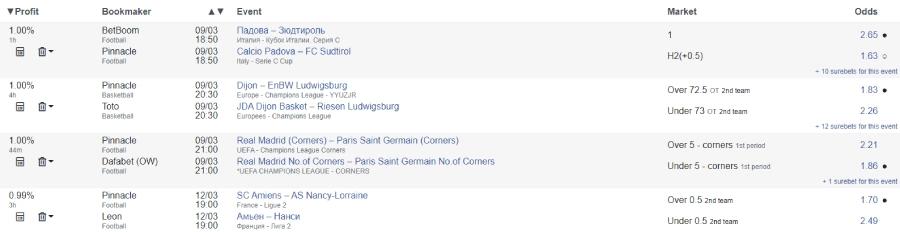
Why consider using this betting software?
- Affordable weekly and monthly subscription options
- Access to value-based betting indicators with each subscription plan
- Visibility into arbitrage-style scenarios with paid plans (subject to availability and bookmaker restrictions)
- Simple and beginner-friendly interface
- Coverage of 190+ bookmakers and 40+ sports (availability varies by jurisdiction)
Price
Sure bets – 1 month – €25.9
Sure bets – 1 week – €8.9
6. BetWasp – automated betting algorithm
BetWasp provides tools that identify arbitrage and value-based scenarios in in-play markets, with optional automation features for experienced users.
The software is capable of highlighting these market discrepancies and, if configured by the user, submitting bets automatically, which requires careful risk consideration.
Properties of this sports betting software
- Developed by BetBurger, a long-running odds comparison and market analysis service
- Covers approximately 15 bookmakers
- Requires users to manually configure settings using their own betting account credentials
- When a market opportunity is detected, users can review it and choose whether to place a bet, including via automation
- Automation features may increase operational risk and are not suitable for all users
Price
- Currently offered free of charge (terms may change)
Are football betting software and algorithms useful?
It is easy to find football betting software online, and many services promote strong claims about results.
Based on my experience, only specific, well-understood mechanisms such as matched betting, arbitrage frameworks, and certain exchange-based trading models can reduce outcome uncertainty under limited conditions — and even these involve operational and account-level risks.
Football analysis tools such as Zcode System or PlayThePercentage can help users evaluate statistical patterns and improve market understanding, but they do not remove risk or guarantee returns.
Bettors with prior experience may find analytical software helpful for decision-making, but outcomes remain uncertain, and losses are always possible.
How to use football betting software or algorithms
The more structured data and historical context you have, the better equipped you are to assess betting markets — though accuracy is never guaranteed.
The tools mentioned above serve different analytical purposes, and none should be relied on as a standalone solution.
1. Football statistics software / algorithms
These tools can be used to cross-check assumptions and test betting ideas against historical data.
They do not provide a guaranteed advantage over bookmakers.
A solid understanding of football markets and odds mechanics is required to interpret the data responsibly.
2. Sure betting algorithms
Services such as OddsBoom and Breaking Bet are commonly used to identify pricing inconsistencies across bookmakers.
In theory, arbitrage scenarios occur when different bookmakers publish conflicting odds.
For example, if one bookmaker offers odds of 2.10 on one outcome and another offers similar odds on the opposite outcome, this may indicate a pricing mismatch.
While this structure can reduce directional risk, execution errors, timing issues, stake limits, voided bets, and account restrictions can still lead to losses.
3. Odds comparison betting software
OddsJam is primarily an odds comparison platform that helps users locate higher prices for the same betting markets.
Consistently selecting higher odds can improve theoretical efficiency over time, but it does not ensure profitability.
Many bettors underestimate how small differences in odds compound over long periods, though variance and losses remain unavoidable.
Free vs paid subscription plans
Paid betting analysis tools typically provide broader data access and fewer restrictions compared to free versions.
Free plans are usually designed for learning and evaluation purposes and often include limitations.
Some users choose to begin with free plans to understand how a tool works before deciding whether a paid version fits their risk tolerance and budget.
Subscription costs should always be evaluated relative to personal financial limits, as no software can reliably offset poor decision-making or eliminate losses.
What is a sports betting algorithm capable of?
A sports betting algorithm is designed to process large volumes of data and identify patterns or inconsistencies that may be difficult to spot manually.
These may include pricing differences, statistical anomalies, or market movements.
Some services advertise guaranteed or risk-free outcomes; such claims should be treated with caution.
Even advanced algorithms cannot predict sporting outcomes with certainty.
Most algorithms were developed by experienced bettors for internal use, and public versions often behave differently at scale.
A sports betting algorithm may:
- Compare odds across bookmakers
- Highlight higher available prices
- Identify potential arbitrage or value-based scenarios
- Display statistical forecasts based on historical data
- Analyze betting system performance over time
- Trigger alerts for in-play market changes
- Offer optional automation features (which increase execution risk)