
Automated arbitrage betting bot/software: Are there any?
The idea of using an automated arbitrage betting bot is often discussed among bettors who are interested in reducing manual work and execution time.
After several years of experience with arbitrage betting and closely following discussions across forums and technical communities focused on both manual and automated approaches, the following observations summarize the current state of this topic.
What is an automated arbitrage betting software?
An automated arbitrage betting software is capable at least of calculating the right stakes for each outcome of a sure bet and in some cases, place bets automatically at the corresponding odds.
In a fully automated setup, such software would need to collect odds data from multiple bookmakers, identify arbitrage situations, calculate correct stakes, and execute the bets without manual input.
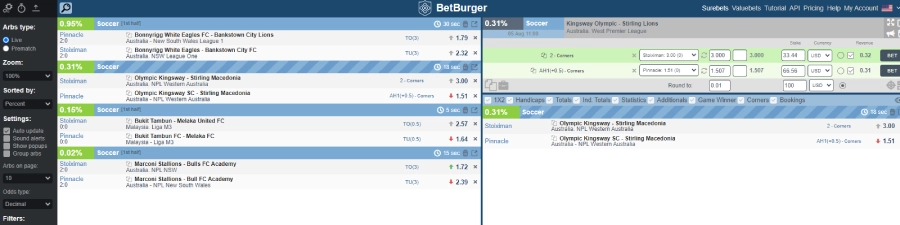
To reduce execution errors, such systems typically place one bet at a soft bookmaker and the other at a bookmaker known to tolerate arbitrage activity.
Operating an automated arbitrage system requires a strong understanding of how arbitrage betting works, including its technical limitations and potential failure points.
In practice, successful arbitrage betting involves many edge cases that require judgment, contextual awareness, and quick decisions.
This complexity is one of the main reasons why fully functional and reliable automated solutions are rare.
Is there an automated sports betting arbitrage bot?
At the time of writing, there is no widely accessible arbitrage betting bot that operates flawlessly without supervision.
There are many unfinished projects, experimental scripts, and partial implementations available online, including repositories shared on platforms like GitHub.
However, users looking for a ready-to-use, fully automated solution should be cautious and realistic about current limitations.
The closest alternatives to automation are advanced arbitrage and value betting tools such as BetBurger and BetWasp.
Both products are developed by the same company.
They function primarily as high-speed arbitrage and value bet detection platforms rather than fully automated betting bots.
BetBurger focuses on a broad international market, while BetWasp concentrates mainly on bookmakers operating in the United States and Canada.
A key feature of these tools is their redirection functionality.
When clicking on a detected arbitrage opportunity, the system opens the relevant betting markets directly at the bookmaker.
This reduces the time between identifying an opportunity and manually placing bets.
What are the steps to automate arbitrage betting?
1. Scrape bookmakers or obtain an odds API
Before attempting automation, it is necessary to understand arbitrage betting in depth and determine how odds data will be sourced.
A functioning system requires fast, accurate, and reliable odds data.
This data can be obtained either by scraping bookmaker websites or by purchasing access to an official odds API.
Scraping bookmakers often exists in a legal and contractual grey area and may violate bookmaker terms.
Some services, such as BetBurger, offer odds data through APIs, which can serve as a technical foundation for building automated tools.
Using an established data source is generally more stable than attempting to maintain custom scrapers.
2. Develop the automated arbitrage system
Once data access is available, development requires either strong programming skills or hiring a developer.
Both options involve significant time, cost, and technical complexity.
Building an automated arbitrage system without practical arbitrage betting experience introduces additional risks, as subtle market behaviors can be difficult to anticipate.
Having to ask a developer to build an automated arbitrage betting finder service with zero knowledge about sure betting will be a big challenge.
Determining whether this effort is worthwhile depends on the user’s technical background, resources, and tolerance for operational complexity.
3. Monitor execution and results
Even with a functioning automated system, continuous monitoring remains necessary.
Manual arbitrage bettors already face challenges when covering both sides of a bet consistently.
Automated systems lack human judgment and may struggle to handle unexpected situations, such as rapid odds movement or suspended markets.
For example, odds often change quickly in pre-match markets.
At a minimum, an automated system should detect execution failures and alert the user when one side of a bet is not placed successfully.
There are numerous scenarios where automated execution can fail, requiring human intervention.
Can you automate arbitrage betting?
In theory, automated arbitrage betting is possible.
In practice, feedback from developers and bettors indicates that error rates remain relatively high.
These errors make fully automated systems difficult to operate consistently over time.
The most reliable form of automation currently available is the rapid identification of arbitrage opportunities.
Compared to manual searching, automated scanners significantly reduce the time required to find opportunities and increase the number of bets that can be evaluated.
Difficulties of automated sure betting bots
Speed
Speed is a critical factor in arbitrage betting.
Opportunities often appear and disappear within seconds.
Even a delay of one or two seconds can result in missed opportunities or reduced betting volume.
Accuracy
Speed alone is insufficient.
Automated systems must correctly match equivalent markets across bookmakers.
Even established arbitrage tools sometimes display opportunities that result from mismatched markets.
Placing bets based on incorrect market matching can lead to unbalanced exposure.
Executing automated bets without validation can result in substantial losses over a short period.
Error handling
When an automated system fails to place all required bets, it should immediately notify the user.
In such cases, manual intervention may be needed to hedge exposure at different odds or alternative bookmakers.
